
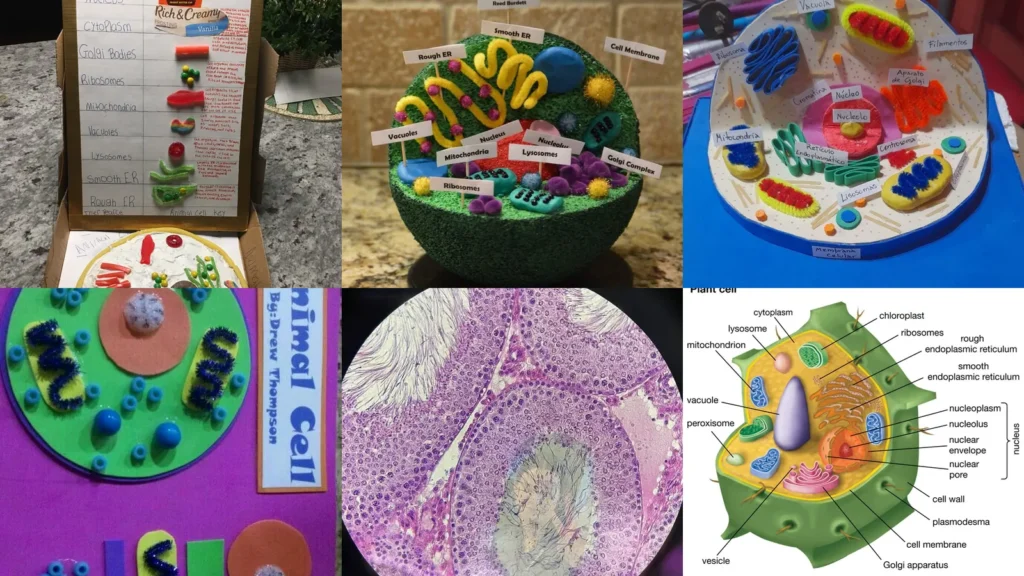

Looking for an animal cell project with a little more color? Think candy-covered models, bright folded shapes and tiny labels that show where everything belongs.
These pictures give you plenty to work with, whether you’re planning a flat display or a rounded cutaway.
You can keep things simple or go all out.
Cell project inspiration worth a closer look
candy model with a matching key

We’re starting off strong with this colorful model and its matching display key. I love how the yellow border surrounds the white surface, with red fish shapes and green strips arranged inside.
For your own animal cell project, try a separate key like this one. Matching each model piece to a sample beside its name keeps the little labels off the model itself.
a starting-point supply spread

Not ready to build the whole thing yet? This picture shows the starting pieces rather than a finished cell: a large white sphere, a smaller ball, shell-shaped pieces and a container of green liquid.
You could sketch your organelle layout before putting anything together. There’s no finished arrangement here to copy.
watermelon cutaway

How fun is this watermelon model? The upright back gives the labels room to spread out, while a kiwi slice, orange segments and red strips fill the open center.
I especially love the little flags. If you try a food-based version, keep the labels clear of one another and remove every stick before anyone eats it.
pink edges and a sparkling center

This bright cutaway may just be one of my favorites here. I love the pink outside and yellow interior, plus that silver-colored center with its bold red middle.
Try giving each type of structure its own color in your version, like the purple and turquoise folded shapes here.
green cutaway with yellow loops

The yellow loops look so good against this dark green background. Some have little pink dots attached while others are plain, giving the two labeled ER sections a visible difference.
Keep that distinction if you borrow this idea: rough ER has attached ribosomes, while smooth ER does not.
pink cookie display

I love the pink surface and the colorful candy border on this round display. The large brown center leaves plenty of space for smaller pieces and upright flags around it.
There’s one label you shouldn’t copy for an animal cell: the cell wall. Animal cells have a cell membrane but no cell wall, so this example needs that correction.
yellow circle with shiny details

If you like a little sparkle, this one is for you. The pink and blue center, purple clusters and curved rows of orange beads all stand out against the yellow circle.
The raised green strips add another shape without hiding the background. I’d keep the white labels simple like these.
blue border and folded shapes

There is so much color in this little cutaway! The blue border matches the display board, with green folds, orange loops and a pink center inside.
The pictured labels are in Spanish. You could follow the same compact label style in the language your assignment requires, checking each name and placement against your class diagram.
red model with stitched details

How cute is the yellow-and-purple center? The visible stitching around those shapes gives this red model a different look from the other rounded displays.
Green and cream loops sit around the edges with small white labels. If you want to borrow one detail, I’d choose the contrasting outlines around the center.
orange outline and bright loops

Don’t want a tall cutaway? This flatter white model gives you another option.
I love the orange outline and the bright blue loop near the top.
The large title sits above the smaller handwritten flags. For your version, leave a little extra space between flags so none of the names cover the shapes.
blue model on a green stand
If you are looking for a bold display, then this one is for you. There’s a deep blue outside, a dark teal interior and a bright green stand with a large title.
The yellow folds around the pink center are my favorite part. A raised base like this is also an idea to consider when planning where your project title will go.
purple board with a side key

Want the model and explanation together? This purple board pairs a green circular cell with a separate row of matching shapes and a printed key.
I love how the blue pieces repeat across the display. Borrow the side-by-side layout, but check the written definitions against your textbook rather than copying them straight from the picture.
bright blue candy cutaway

This blue model is anything but plain! A raised green center sits beside folded red and blue strips, with colorful round candies scattered around it.
The separate white key leaves the model open to view. Notice the red-and-yellow pieces projecting from one edge too; they’re identified as microvilli in the pictured key.
colorful labeled diagram

Need a drawing idea rather than another 3D model? This diagram has a light purple cell interior, a yellow nucleus and a dark blue outer border against a white background.
You could use a similar layout for a hand-drawn poster, with names outside the cell and lines pointing inward. Check every pointer as you draw, especially where several structures sit close together.
a view through the microscope

Here’s something different from the bright models above. This microscope image shows many small purple-stained structures grouped around pale open areas, not one isolated cell with neatly separated organelles.
You could include a microscope view alongside your model to discuss that difference. Confirm the specimen identity before adding a specific tissue name.
black-and-white study drawing

Don’t want to start with a rainbow of colors? This black-and-white drawing shows a detailed cutaway with lettered pointers and a matching name key above.
For your own drawing, try assigning a color to each structure and using the same color in the key. Keep the fine internal lines visible rather than covering them with dark coloring.
green plant-cell comparison box

This is a plant cell model, so it isn’t one to copy unchanged for an animal-cell assignment. The rectangular display includes labeled chloroplasts, a cell wall and a large blue vacuole.
I do love the roomy arrangement inside the green box. Save this picture for a comparison section if your assignment includes both cell types.
green-sided comparison model

The blue folded shapes at the front are such a striking detail. This model also has tall green sides, a pink inner border and a large blue-gray area toward the back.
The labels include chloroplasts and a cell-sap vacuole, making this another plant-cell example rather than an animal-cell model. Keep it in a comparison section instead of copying the whole arrangement.
plant diagram with a cutaway wall

This diagram gives you a closer look at the plant-cell differences. The thick green outer wall surrounds a yellow interior, with green chloroplasts and a large purple vacuole clearly pictured.
For a comparison poster, you could place your animal-cell drawing beside it. Show the cell membrane in both, but leave the cell wall and chloroplasts out of the animal version.
Just a little note - some of the links on here may be affiliate links, which means I might earn a small commission if you decide to shop through them (at no extra cost to you!). I only post content which I'm truly enthusiastic about and would suggest to others.
And as you know, I seriously love seeing your takes on the looks and ideas on here - that means the world to me! If you recreate something, please share it here in the comments or feel free to send me a pic. I'm always excited to meet y'all! ✨🤍
Xoxo Giulia
Related stories
- 20 Car Interior Decor Ideas With Flowers, Bows and Little Personal Touches
- 19 Ghost Pizza and Spooky Pizza Ideas for Halloween
- 20 Trim Paint Colors and Combinations Worth Saving
- 20 Gingerbread Man Activities You'll Love to Try This Year
- 20 Fall Crafts for Toddlers and Playful Autumn Activities
- 20 Homecoming Dress Ideas for Freshman Year, From Bows to Sparkle